

The year 2025 brought significant differences in the financial results of both icons. Mattel ended the period with a 1% decline in revenue to 5.3 billion USD, pulled down by weaker demand in the U.S. Global markets, however, grew. The development led to a decline in gross margin to 48.7%, pointing to rising costs and higher discounts during the year. Hasbro reported 14% growth to 4.7 billion USD. Growth was driven by the digital gaming segment, which increased by 45% thanks to strong performance, for example, from the game Magic: The Gathering. However, Hasbro faced a significant imbalance between segments, where digital and licensing activities grew strongly, while the traditional products segment and the entertainment division declined by 4%. As for operating profit, Mattel’s fell by nearly 150 million USD to 546 million USD. On the other hand, Hasbro reported a 36% increase to 1.14 billion USD and at the same time generated a significantly higher adjusted operating margin of 24.2%. Looking at the fourth quarter of 2025, revenues of both companies grew year-on-year. In Mattel’s case, this was 7%, while Hasbro’s sales added 31%. In terms of earnings per share, Mattel reduced earnings per share to 0.34 USD, while Hasbro achieved adjusted earnings per share of approximately 5.54 USD.
Green versus red
The companies also differ in their performance on the Nasdaq exchange. While Hasbro’s shares were trading near historical highs, Mattel, on the other hand, is in the red. The latter recorded a rapid share price correction of more than 24% after publishing its financial results on February 10, 2026. In terms of performance over the past year, the development of both companies is in sharp contrast. While Mattel declined by about 20%, Hasbro achieved a gain of more than 52%. The companies showed a similar movement from a 5-year perspective. As of February 28, 2026, Hasbro shares were at 100.36 USD and Mattel shares stood at 17.08 USD.*
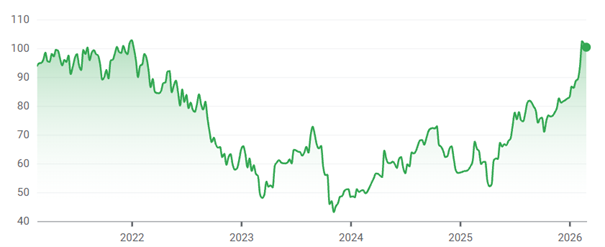
Development of Hasbro’s share price over the last 5 years. Source: Google Finance*
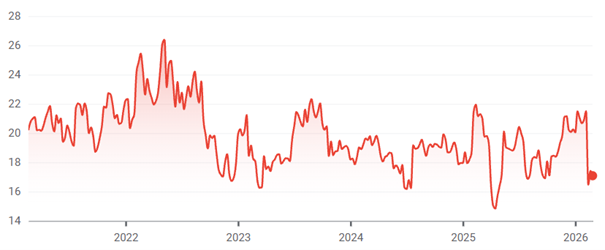
Development of Mattel’s share price over the last 5 years. Source: Google Finance*
What makes them different?
The differences between the performance of the two toy giants are the result of a combination of product strategy, a changing market, and adaptation to new customer categories. Digitalization is key in this case. In recent years, Hasbro has significantly invested in digital products and games, which today make up an increasing part of the toy business and a significant share of its revenues. Mattel has not yet managed to transform its strongest brands in a way that would allow them to benefit from this trend to the same extent. At the same time, Hasbro successfully targets adult audiences who are more willing to spend on complementary products. Mattel, in contrast, focuses on physical toys, which remain important but are mainly seasonal and sensitive to price pressure and supply chain issues. Although Mattel owns strong brands such as Barbie and Hot Wheels, their monetization in the digital environment still lags behind the competition. There is also a difference in response to market pressures. Hasbro adjusted its marketing faster and focused on higher-margin products, while Mattel devoted more attention to optimizing existing physical production, which translated into slower growth dynamics.
Dolls and turtles
If Mattel wants to change its momentum in the near term, it should focus primarily on its key brands and new partnerships. An important moment is, for example, the anniversary of the American Girl dolls, which the company leveraged to its advantage. According to CNBC, it recorded increased interest in the brand thanks to the 40th anniversary and supported sales with special and limited editions. Mattel therefore did not focus only on children, but the target category also included adults who grew up with the iconic dolls. On the other hand, this proves that it continues to rely on traditional pillars, namely dolls. Despite their global distribution, they are limited by the aforementioned seasonality and market development. An important step was also the conclusion of a partnership with Paramount Global and their Teenage Mutant Ninja Turtles franchise. The fighting turtle team has a strong fan base across generations, enabling the distribution of toys and other collectible items. The potential is further enhanced by expansion into the digital and film world. Similar partnerships can help Mattel diversify revenues and reduce dependence on its own traditional brands. The question, however, remains whether it can leverage this license quickly and effectively enough for it to be reflected in full-year revenue growth.
Wizarding world
While Mattel bet on turtles, Hasbro chose the path of the wizarding phenomenon. Thanks to cooperation with Warner Bros. Discovery Global Consumer Products, it will bring products from the world of Harry Potter to the market, covering a wide range from classic action figures to board games. Warner Bros. President Robert Oberschelp stated in a press release that there will be new innovative toys also from the world of Fantastic Beasts and the newly prepared HBO series, which will premiere next year. Similarly to the case of the Ninja Turtles, the enormous popularity of the wizarding brand, which continues to enjoy interest even after 25 years, gives Hasbro a stable base for repeat purchases, and therefore represents a strategic expansion of the product line.[1]
* Past performance is not a guarantee of future results.
[1] Forward-looking statements are based on assumptions and current expectations that may be inaccurate, or on the current economic environment, which may change. Such statements are not a guarantee of future performance. They include risks and other uncertainties that are difficult to predict. Results may differ materially from those expressed or implied in any forward-looking statements.



.svg)
.svg)