

During 2024, cocoa prices rose to historical highs and at one point even exceeded 12 000 USD per ton. Since then, the situation has changed dramatically, and prices have gradually fallen below 4 000 USD. Since the beginning of the year alone, cocoa has lost more than 43%, and as of March 16, 2026, the price of front-month CC1 contracts on the US ICE futures exchange stood at 3 396 USD. Looking at the yearly chart, contracts were down 58%. However, from a 5-year perspective they remained in positive territory at 35%. The sharp price decline is also confirmed by reports from financial markets, according to which cocoa reached multi-year lows on both the London and New York exchanges.*
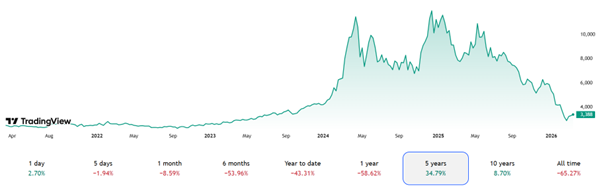
Development of prices of front-month cocoa CC1 contracts over the past 5 years. Source: Trading View*
Relief for the harvest
One of the main reasons for the decline is the improving production outlook in West Africa. According to Reuters, recent weeks in “cocoa regions” have brought above-average rainfall, which improved the growth of cocoa pods and increased expectations of a higher harvest. Weather had been one of the main drivers of price increases in previous years, as droughts and diseases significantly damaged crops. According to analysts, this confirms the classic dynamics of commodity markets, where periods of extremely high prices are often followed by rapid corrections.
A shift in market balance
However, falling prices are bringing new problems in the supply chain. Due to slower purchases by traders, harvested cocoa beans are piling up in warehouses and spoiling. This development occurred in combination with falling prices and weaker interest from chocolate processors. The problem arose within the sales system itself in West Africa. Reuters reports that local governments set fixed prices for the crop at the beginning of the season. When global prices change sharply, such a system creates significant tension between farmers, traders, and the state. In some cases, traders refuse to buy cocoa at prices higher than the current market value, which leads to part of the harvest not reaching the market in time. This situation ultimately affects farmers the most, as they have already sold their harvest to the state but, due to lack of interest, are not getting paid. One farmer had to sell a large part of his harvest to illegal sand miners, as sales have fallen from 300 bags to 50 units in recent years.
Interventions in prices and the trading system
To stabilize the sector, Ghana and Ivory Coast, which together produce approximately 60 to 70% of the world’s cocoa, have begun taking measures. According to Reuters, the government of Ivory Coast has decided to significantly reduce the purchase price of cocoa for farmers, with the new season price expected to drop by more than half. This would mean a reduction to approximately 800 to 1 000 CFA (1.45 – 1.81 USD) per kilogram from the original 2 800 CFA. This followed a decision that cocoa is no longer a primary crop but a secondary one. It also involved a change in the growing season – now from March to August (previously April to September), and in addition, the government will purchase 100 thousand tons of unsold cocoa from farmers for half a billion USD. A similar step was taken by Ghana, which reduced the guaranteed price for farmers by approximately 28%. The aim of these measures is to align domestic prices with current global market conditions and restore trader interest.
Market reforms
Countries have also begun considering broader changes. For example, Ivory Coast is considering changes to the cocoa sales system through long-term contracts. According to Reuters, there is also discussion about the possibility of more direct sales of cocoa to manufacturing companies or strengthening the role of domestic traders. Analysts warn that these reforms could significantly change the functioning of the global cocoa market. At the same time, they caution that stabilizing the sector will not be easy, as the market is highly dependent on global demand for chocolate. Future developments will therefore depend not only on decisions by African governments but also on how consumption of chocolate products evolves in global markets.
* Past performance is not a guarantee of future results



.svg)
.svg)