

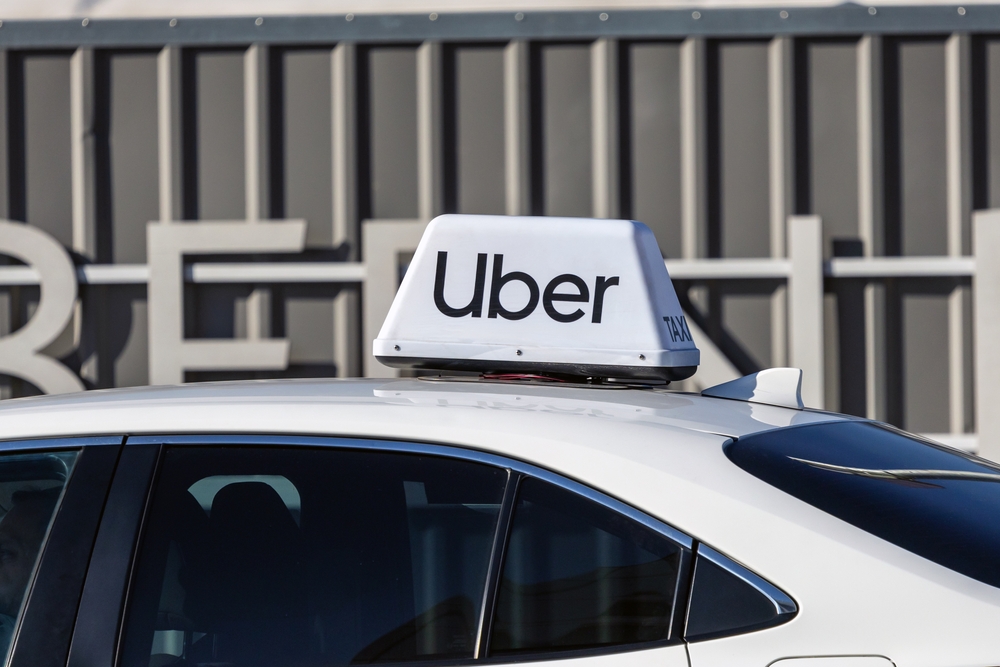
Uber has long ceased to be just a regular taxi service and is moving toward offering broader logistics services. Similar to other companies, the winter holiday season is one of the most important times of the year, and therefore it launches services that could relieve people from stress. For example, by introducing shared rides at some of the largest international airports in the USA – J.F.K. and LaGuardia in New York and Orlando Airport in Florida – which join dozens of airports in the country offering this option. Another new feature is “Send a Ride,” where with just a few clicks, users can pick someone up at the airport. The seasonal offering is also complemented by Uber Ski, through which customers can call larger vehicles that will transport them along with their skis to ski resorts across the USA. A bonus, thanks to the partnership with ski resort operator Vail Resorts, is the ability to purchase a ski pass. However, the feature is not entirely new, as the service has already been available for some time on the Old Continent – for example, in Poland, Switzerland, Austria, and Belgium.
Autonomy at Uber
Autonomy is currently at the core of innovation in every modern company, and Uber is no exception. Small robots will begin delivering food ordered through Uber Eats starting in December this year. The first city to receive this innovation is Leeds in the UK, with plans to expand further into Europe and the USA by 2027. The robots were developed in cooperation with Starship Technologies, a leader in autonomous delivery with nearly 3,000 robots. In a press release, the CEO of Starship Technologies said that the collaboration with Uber is building the infrastructure for the next generation of urban logistics, while Uber's CEO described it as an exciting part of the future of Uber Eats.
Driverless cars coming soon
A bolder step is the robotic taxis with which the American company will expand its fleet of cars. At the end of October, it announced 5,000 such taxis, which will be manufactured by Dutch company Stellantis and powered by advanced technologies from Nvidia. The vehicles will be available internationally, and Uber will retain complete control over their operation. To make rides safer and more efficient, both companies will deploy a data factory, utilizing 3 million hours of driving data from these vehicles. Uber is also expanding its driverless taxi portfolio with other manufacturers, such as the American Lucid, which will result in approximately 20,000 vehicles on the roads over the next six years, with the start of full operations in 2026.
Dynamic Growth Over Recent Years
The company’s success is also visible in its financial results. In Q3 2025, Uber exceeded several indicators and recorded the strongest growth in the past two years, which CEO Dara Khosrowshahi attributed to innovation and affordability, according to CNBC. Orders during the period increased by 21% to nearly 50 billion USD, while the monthly active user count rose to 189 million. This robust change resulted in a year-over-year revenue growth of 20% to over 11 billion USD. Net profit reached 6.6 billion USD, three times higher than in 2024. Revenue in individual segments also saw double-digit growth - mobility increased by 20%, and delivery Uber Freight by 29%.
Stocks Below All-Time Highs
Although quarterly results were positive, Uber shares on the NYSE fell more than 5% on the day of their announcement (November 4, 2025). Nevertheless, they remain at high levels, below the historical highs from early October when the price was just above 100 USD. On the trading day of November 25, 2025, they closed at 83.69 USD, indicating room for further growth. Over the past year, the stock price increased by nearly 17%, and over a longer five-year period, it rose by 64%.*
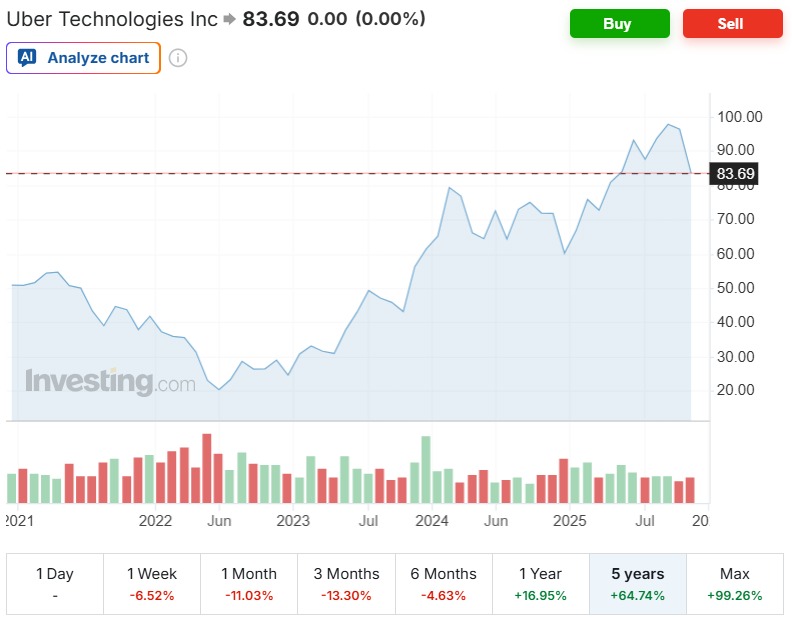
Source: Investing.com*
Future Outlook
In the last quarter of the current year, Khosrowshahi expects continued revenue growth in the range of 52.25 to 53.75 billion USD. He also told CNBC that he views the situation positively but continues to monitor the global environment, including macroeconomic issues. Encouraging estimates confirm Uber’s currently “momentum-driven” dynamics. In the long term, it will be important how autonomous taxis and delivery robots are integrated in practice, and especially in today’s rapidly changing world, further strategic changes will be necessary. If Uber can meet high expectations and goals, it could be well-positioned for growth in 2026.[1]
*Past performance is not indicative of future results.
[1] Forward-looking statements are based on assumptions and current expectations, which may be inaccurate, or on the current economic environment, which may change. Such statements are not a guarantee of future performance. They involve risks and other uncertainties that are difficult to predict. Actual results may differ materially from those expressed or implied in any forward-looking statements.


.svg)
.svg)