

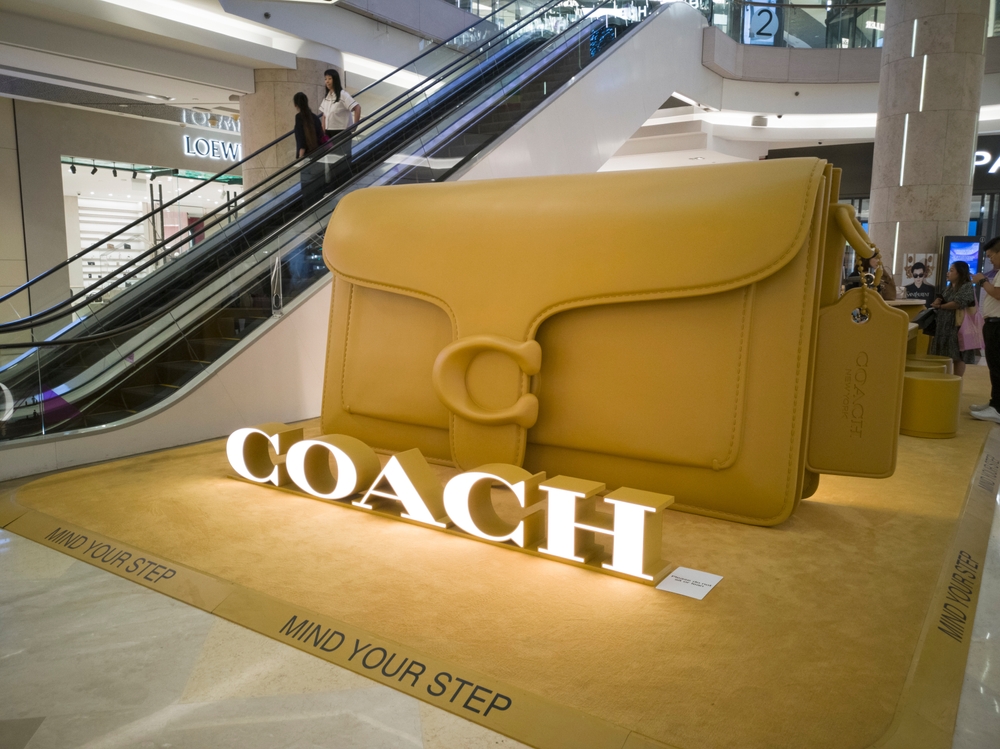
The luxury fashion industry is facing more cautious consumers who are increasingly considering what they are willing to pay for. However, not all brands are feeling the slowdown in demand equally. American brand Coach has managed to maintain customer interest and is gaining popularity, particularly among the younger generation. Its success is also reflected in the financial results of its parent company, Tapestry. At the same time, however, the company is facing diverging performance across its brands, as Kate Spade lags behind Coach’s growth.
Coach lifted results higher
American company Tapestry, which owns the well-known brands Coach and Kate Spade, released its financial results for the first quarter of fiscal year 2027 in early November, reporting that its revenue rose by 11.1 % year on year to USD 1.89 billion. This figure exceeded market estimates of USD 1.86 billion. Adjusted earnings per share (EPS) stood at USD 1.82, exceeding the expected level of USD 1.57. Operating profit also improved, rising by 29 % to USD 424 million, with net income of USD 360 million. This success was mainly driven by Coach, whose revenue grew by 16 %, accounting for almost 88 % of total revenue. Kate Spade, by contrast, recorded a decline of 10 %. The difference between the brands points to differing customer responses to current trends and pricing strategies. Tapestry subsequently raised its full-year revenue outlook from the original USD 8.4 to 8.5 billion to USD 8.5 to 8.6 billion, while increasing its estimated adjusted EPS to USD 8.25 to 8.35. This move therefore suggests that the company continues to expect strong demand for its brands during the upcoming holiday season.[1]
The younger generation is changing the rules of luxury
The most significant driver of Coach’s growth is its ability to appeal to younger customers. According to its quarterly results, Tapestry acquired approximately 2.6 million customers in the quarter under review, around 35 % of whom belonged to the younger Gen Z generation. Coach aims to attract customers looking for a combination of brand, quality and a more affordable price compared with expensive luxury brands. Coach’s flagship products are handbags priced between USD 200 and 500. The brand’s popularity is supported by accessories, handbag personalisation and marketing campaigns featuring personalities popular among young people. These included, for example, actress Elle Fanning and South Korean singer So-yeon. This interest was reflected not only in the growing number of customers but also in their willingness to pay a higher price. The average selling price of Coach handbags grew at a double-digit rate year on year, while the number of units sold also increased. For Tapestry, this is a favourable combination that supports margins and reduces the need for substantial discounts.
China surprised, Kate Spade lags behind
Tapestry’s growth was not limited to the US market, although North America remains its largest region. Revenue there reached USD 1.11 billion, rising by 4 % year on year. The company recorded significantly more dynamic performance in China, where revenue increased by a robust 43 %. In Europe, sales rose by 20 %, and in other Asian countries by 26 %. The results in China are particularly interesting because several luxury groups, including Kering, LVMH and Hermès, are struggling in this market with weaker demand and geopolitical and trade uncertainties. This suggests that customers may be more inclined to seek brands offering a more attractive balance between price and value. However, Coach’s growth contrasts with Kate Spade’s results. The latter is trying to revive customer interest and improve its market position by limiting the extent of discounts and adjusting its product offering, but this has yet to translate into renewed revenue growth. The differing results also increase the entire group’s dependence on Coach’s success, which could become a risk in the future if consumer preferences change. On the other hand, a potential recovery at Kate Spade would open up another source of growth for the company.[2]
Shareholders reacted positively
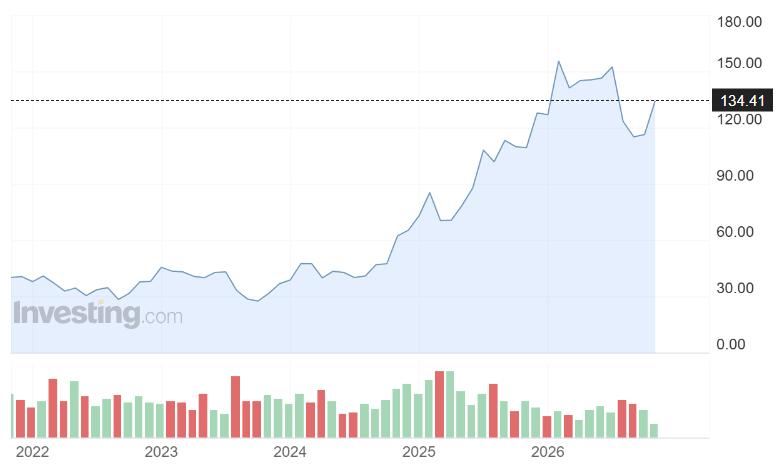
The positive financial results and raised outlook were also reflected in the reaction of investors on Wall Street. Tapestry shares rose by approximately 7 % on the NYSE following the announcement of the results on 5 November 2026.* Investors appreciated the company’s ability to exceed expectations even at a time when the luxury sector is facing weaker consumer demand. Tapestry also continues to pay dividends and repurchase shares, with plans to buy back USD 1.7 billion worth of shares in fiscal year 2027 and distribute a total of USD 2 billion, including dividends.[3] Over the past year, the share price increased by almost 30 %, while over the past five years it rose by as much as 195 %. The shares reached an all-time high in August 2026 at a price of more than USD 164, while their price stood at USD 134 as of 11 November 2026.
Source: Investing*
Can Tapestry maintain its lead?
The positive outlook suggests that the company’s management expects favourable consumer behaviour to continue in the coming quarters. For the second quarter, it expects revenue growth of 5 to 6 % and adjusted earnings per share of approximately USD 3.05.[4] The company does not currently plan to use more aggressive pricing to support sales, as it says its offering is competitive. However, Tapestry’s performance could be influenced by several factors, ranging from trade tariffs and exchange rates to consumer confidence, particularly among Gen Z. Expansion into additional countries also presents an opportunity, especially in Asia, where Coach performed well.
* Past results are not a guarantee of future results.
[1,2,3,4] Forward-looking statements are based on assumptions and current expectations that may be inaccurate, or on the current economic environment, which may change. Such statements are not a guarantee of future performance. They involve risks and other uncertainties that are difficult to predict. Results may differ materially from those expressed or implied in any forward-looking statements.
This text constitutes marketing communication. It does not constitute any form of investment advice or investment research, nor an offer of any transaction involving a financial instrument. The content of the text does not take into account readers’ individual circumstances, experience or financial situation. Past performance is not a guarantee or prediction of future results. Wonderinterest Trading Ltd. is an entity regulated by the Cyprus Securities and Exchange Commission.