
Customers associate Amazon primarily with shopping, but technology is also making up an increasingly large part of its business. Cloud services are growing thanks to companies’ demand for computing power and the development of artificial intelligence. The latest financial results also show how costly it is to keep pace with this interest. The company must therefore convince the market that substantial spending is creating room for future revenue. It is also finding further growth opportunities in everyday grocery shopping, while its planned acquisition of Globalstar is bringing it closer to expanding its services to include direct satellite connections with mobile devices.
Different rates of growth
The technology giant managed to increase revenue by 12 % to almost USD 201.94 billion in the third quarter of 2026. Although this is a solid result, analysts had expected somewhat more, namely revenue of USD 202.31 billion. As for net income, it fell year over year to USD 20.69 billion from USD 21.19 billion. This represented earnings per share of USD 1.89, which also fell slightly short of market estimates (USD 1.96). This negative development was mainly influenced by the fact that Amazon reported a pre-tax gain of USD 9.5 billion from its investment in Anthropic last year. As for the individual divisions, online sales revenue (USD 68.47 billion) fell short of forecasts, and advertising was in a similar position (USD 19.64 billion). In this case, the shift of one of the important events, Prime Day, into the second quarter contributed to the development, and some advertising-related purchases also took place earlier. On the other hand, there is the Amazon Web Services (AWS) cloud segment, which exceeded expectations. Its revenue grew by 39 % to just under USD 46 billion, while operating income rose by a robust 55 % compared with last year to more than USD 17 billion. AWS accounted for approximately 23 % of Amazon’s total revenue, representing its highest share to date.
Growth will require further spending
AWS’ strong results are also reflected in Amazon management’s ambitions for the coming years. CEO Andy Jassy expects the cloud division’s revenue to grow by more than 40 % annually through 2028. According to him, growth in core computing and storage services used in everyday operations is also accelerating. Amazon is therefore continuing to expand capacity and recently also announced plans to purchase more Nvidia chips. At the same time, it is developing its own Trainium chips, which will be used to train AI models and should also become accessible outside AWS late next year. These plans naturally involve high capital costs, which the company estimates at USD 220 billion this year, and Jassy expects them to increase further in 2027. The company is somewhat more cautious about its short-term outlook for company-wide revenue, which also includes the important holiday season. In the final three months, it expects revenue of USD 240 – 247 billion, but the middle range of USD 243.50 billion is below the market forecast of more than USD 244 billion.[1]
Investors are watching returns
Weaker results and expectations of further spending were also reflected in the market’s reaction, which was not the most positive. After the results were released on 29 October 2026, Amazon’s share price fell by more than 7 %.* Capital expenditure in the third quarter exceeded USD 77 billion, which was 2 times as much as in 2025. Spending also exceeded estimates by approximately USD 18.6 billion. The level of spending was also affected by free cash flow, which represents the company’s cash after deducting investments. Over the period September 2025 – 2026, more than USD 42 billion flowed out of the company, which management explained by purchases of property and equipment related to AI. The shares recovered at the beginning of November and erased the correction, trading at USD 250 as of 4 November 2026. From a long-term perspective, over 1 and 5 years, the shares were in the green*
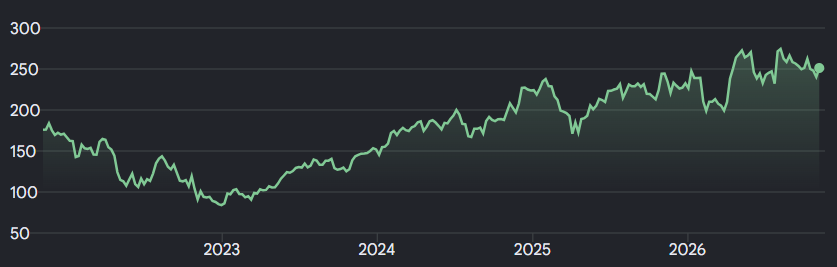
Source: Google Finance*
Groceries also support other purchases
However, Amazon does not specialise only in the IT sector or the sale of various goods, but also focuses on fresh groceries, and demand is solid. The company’s management stated that the monthly number of orders placed by Prime programme members for same-day delivery had more than tripled, while fresh groceries and everyday essentials grew approximately three times faster than the rest of the store in the third quarter. This segment is important for Amazon because customers buy not only groceries but also other products. According to the data, customers buying groceries with same-day delivery purchased 7 times as many units of other products compared with those who have goods delivered on a different day. They also spend more on clothing, home furnishings and other items. Delivery expansion continues despite the company closing its brick-and-mortar Amazon Fresh and Amazon Go stores earlier this year. In brick-and-mortar store sales, however, it continues to develop the Whole Foods Market chain, which Jassy says is growing faster than the rest of its grocery business. These plans also include the continued opening of smaller Daily Shop stores.
New possibilities for satellite connectivity
Alongside expanding services for everyday shopping, Amazon is also investing in satellite connectivity. In Kirkland, Washington, it built a manufacturing network for Leo satellites and announced in early October that it had produced more than 1 000 satellites. To deploy them, the American company managed to establish partnerships with providers for more than 100 launches, and since April of last year it has already managed to send approximately 400 satellites into space. Further expansion in this sector may also come from the planned acquisition of Globalstar worth USD 11.5 billion, which was approved by the US Federal Communications Commission (FCC) in late October 2026. Amazon would thus acquire approximately 20 satellites as well as frequencies for mobile satellite communications, supporting its entry into services enabling direct connections between satellites and mobile phones. Globalstar already provides satellite safety features for Apple, including emergency calls for help. This cooperation with Apple will also continue under Amazon’s umbrella. According to the FCC, it is preparing to launch its own commercial satellite services by the end of 2026. By 2029, it aims to deploy thousands of satellites in low Earth orbit.[2]
* Past results are not a guarantee of future results.
[1,2] Forward-looking statements are based on assumptions and current expectations that may be inaccurate, or on the current economic environment, which may change. Such statements are not a guarantee of future performance. They involve risks and other uncertainties that are difficult to predict. Results may differ materially from those expressed or implied in any forward-looking statements.
This text constitutes marketing communication. It does not constitute any form of investment advice or investment research, nor an offer of any transaction involving a financial instrument. The content of the text does not take into account readers’ individual circumstances, their experience or financial situation. Past performance is not a guarantee or prediction of future results. Wonderinterest Trading Ltd. is an entity regulated by the Cyprus Securities and Exchange Commission.