

Record Figures Were Not Enough
SK Hynix posted a significant acceleration in growth during the second quarter, driven by demand for chips used in data centres and artificial intelligence development. Its revenue increased by 257% year-on-year to KRW 79.32 trillion, equivalent to just under USD 55 billion. Operating profit rose by 557% to KRW 60.54 trillion. Despite delivering its best results in history, the company failed to meet analysts' expectations, who had projected revenue of around KRW 84 trillion and operating profit of approximately KRW 64 trillion. The weaker-than-expected performance was mainly due to delayed deliveries of some advanced products, which also affected revenue recognition despite higher product prices. The company stated that growth continues to be supported by investments from technology giants in AI infrastructure. Strong profitability was also reflected in net cash, which reached KRW 88 trillion at the end of June. The company aims to increase this figure beyond KRW 100 trillion in the future, providing greater flexibility for further growth.
Missed Expectations and Concerns Over Investments
Despite the record results, investors reacted very negatively on the stock market. On 29 July 2026, the company's share price on South Korea's Kospi exchange fell by as much as 15%, before closing the trading session with a slightly smaller loss of 9.6%. In the United States, trading through American depositary receipts opened with a slight decline to USD 130.17, following an almost 9% drop the previous day. The company had only listed on the Nasdaq on 10 July 2026 at USD 168 per share, and by the end of July the price had fallen to USD 131.93.* The decline was not driven solely by doubts over whether the current pace of AI investment can be maintained. Investors were also disappointed by the lack of a more detailed plan from SK Hynix regarding how it intends to use its growing cash reserves, as experts believe uncertainty surrounding dividend policy or share buybacks could reduce the company's attractiveness. The market also compared SK Hynix with its rival Samsung Electronics, which has greater financial strength and has been more aggressive in passing higher costs on to customers. Despite the negative market reaction, many analysts stressed that the company's fundamentals remain strong.
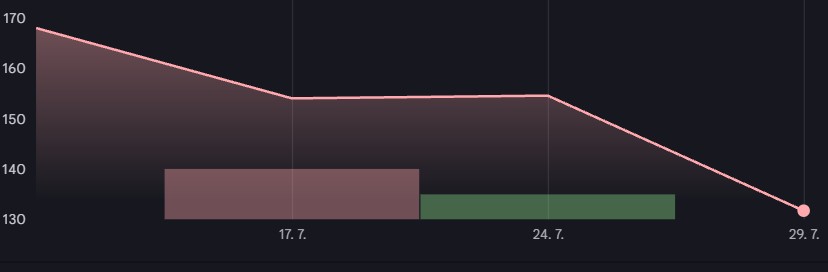
SK Hynix ADR share price performance since its Nasdaq listing. Source: Google Finance*
Entire Sector Dragged Down
The sell-off in SK Hynix shares was not an isolated event but became part of a broader decline across the technology sector. Within a single week, the world's largest semiconductor companies collectively lost more than USD 1 trillion in market value. Besides SK Hynix, the sell-off affected other major players including Nvidia, Samsung Electronics and Micron, as well as the South Korean stock market and the benchmark Kospi index. Investors were therefore reacting not only to SK Hynix's earnings but also to the broader cooling of sentiment towards AI-related stocks. Despite the short-term decline, analysts pointed out that the long-term outlook remains intact, arguing that AI infrastructure investment will continue to grow and that multiple companies can benefit from this trend simultaneously.
AI Boom and Long-Term Partnerships
One of SK Hynix's key strategies is to ensure that the current surge in demand for AI chips is not merely temporary but remains sustainable over the long term. To achieve this, the company is signing multi-year agreements with major technology partners. According to the company, these contracts typically last around five years, and negotiations for approximately ten such agreements have already been completed. A particularly important partnership is with its largest customer, Nvidia. The two companies have expanded their cooperation in supplying memory for AI systems in deals estimated to be worth around USD 500 billion. The partnership is also expected to include the construction of large-scale data centres scheduled to begin operations in 2027. In addition, SK Hynix has joined the broader expansion of AI infrastructure among US technology companies. Together with Samsung, it is expected to participate in planned supplier partnerships for American companies valued at approximately USD 950 billion.
Investments in Capacity
SK Hynix is continuing its aggressive investment strategy, with plans to increase capital expenditure to KRW 40 trillion this year. Last year, capital expenditure totalled KRW 30.2 trillion. These investments will primarily target AI servers, memory products and other advanced semiconductor technologies. The company also stressed that it will not expand capacity indiscriminately but will adapt its plans according to market developments. As part of its expansion strategy, it intends to strengthen production across several South Korean cities. The biggest challenge remains finding the right balance between expanding manufacturing capacity and avoiding the risk of future market oversupply.
* Past performance is not a guarantee of future results.


.svg)
.svg)