

Apple as a Trillion-Dollar Empire
Tim Cook took the helm of Apple in 2011, when he took over the company from Steve Jobs, a company that was different from the one we know today. At the beginning of Cook’s tenure, the market doubted whether he could lead the company in the same way as the visionary Jobs, but later it became clear that his strength was elsewhere. He focused on stability, cooperation and efficient use of what already existed. In decision-making, he trusted the management and did not interfere in the details of product development, but expected teams to know exactly and well what they were doing. This is a huge difference compared to Jobs, who significantly interfered in product decision-making. Professor David Yoffie from Harvard Business School told Yahoo Finance that Cook is among the most successful CEOs of the last 15 years when it comes to creating value for investors, with that value increasing approximately 10-fold. At the time Cook took over, Apple’s value was USD 350 billion and under his leadership he brought it to more than USD 4 trillion. At the end of July, the company even surpassed the psychological threshold of USD 5 trillion.* Cook therefore ,,inherited‘‘ a strong company and at the same time managed to move it to a completely different level. There were also critics who considered his decision-making slower and the pace weaker in the case of innovation. Cook, however, remains at Apple as executive chairman of the board.
From the iPhone to the Entire Ecosystem
Cook’s strategy was based on expanding what Apple already had, namely iPhones, while managing to turn an already successful product into the foundation of a larger ecosystem. Revenue from iPhones accounted for approximately half (USD 209.5 billion) of Apple’s total revenue in 2025. He expanded the business with Apple Services, which ranked among the company’s second-largest segments. Later came Apple Watch, AirPods and services such as Apple Music, Apple TV+ and a fitness app. Apple was therefore no longer dependent solely on iPhone sales. Cook also helped the company’s growth in China, as one of the company’s key markets. In 2025, revenue in China reached more
than USD 64 billion, although the largest market remained the USA. An important part also became the protection of privacy and security, which Apple began using as its competitive advantage. The company even came into conflict with the U.S. government over data protection. At the same time, however, his era also showed its limits, when, for example, Vision Pro did not become the expected hit and Apple has not yet introduced a product that would have a similar transformative effect as the iPhone once did. This is precisely where the space for his successor begins.
Ternus Focuses on the Product
Manager John Ternus joined Apple in 2001 in the product design team and later moved up to the position of vice president and only a few years ago became senior vice president. He worked on headphones, watches as well as Vision Pro and also played a role in the transition of Macs to Apple’s own chips. His work is therefore strongly associated with hardware and details. An emphasis on details is something Ternus shares with Steve Jobs, who the former CEO considered to be one of Apple’s characteristic qualities. His experience with products may be an advantage, as Apple needs to create something that can have a more significant impact on the market.
AI as the First Major Test?
The rules of the technology world are changing and currently focus mainly on artificial intelligence, in which Apple is falling behind. Evidence of this is, for example, the delay of an improved version of Siri, which was first introduced back in 2024. A trial version of the voice assistant will be available at the end of this year, but the problem remains the different conditions for AI to operate in Europe and China. Therefore, the success or failure of Siri could be the first test of the new CEO. For Apple, according to experts, an advantage may be its ability to bring AI directly into devices, rather than building extensive data centers. Ternus will also have to find an answer to the question of what comes after the iPhone, as competitors are already working with various intelligent devices. According to sources, Apple is also working on smart home devices, robots or AirPods equipped with AI cameras. Ternus may meanwhile be helped by his technical background and ability to attract top engineers. The new leadership will have to convince the market that it can keep up in the field of AI.
Huge Market Appreciation
When we look at the situation from an investment perspective, during Tim Cook’s era Apple shares rose by about 2,500%, while this year alone saw an increase of almost 20%, thus outperforming most other technology companies. At today’s market capitalization, it will be much harder for Ternus to repeat the same pace of growth. He is also taking over at a time when there are pressures from rising costs. Over the past 5 years, the shares have risen by 110%, while as of September 3, 2026, the share price was below USD 325. What was a positive signal was the 3.15% increase in the share value during trading on September 1, 2026*, when Ternus officially took over as the new CEO of Apple. In conclusion, it can be said that Cook managed to turn the iPhone into a huge ecosystem, but for investors it will not be important whether Ternus will be the second Cook or Jobs, but whether he can find a new reason why Apple’s value should continue to grow.
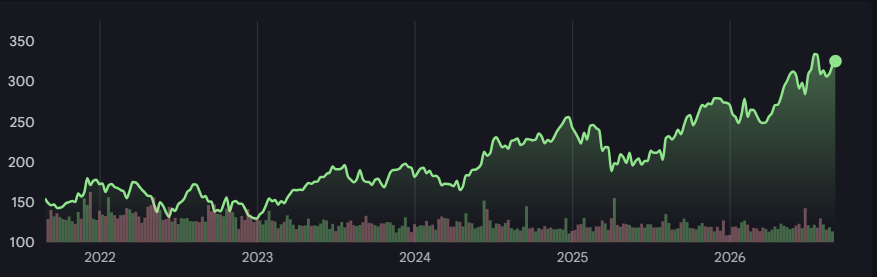
Source: Google Finance*
* Past performance is not a guarantee of future results.
This text represents marketing communication. It does not constitute any form of
investment advice or investment research, nor an offer of any transaction involving a financial instrument. The content of the text does not take into account the individual circumstances of readers, their experience or financial situation. Past performance is not a guarantee or prediction of future results.

.svg)
.svg)