

De Beers Backs Down
The British multinational company has introduced changes to its sales model. According to Bloomberg, it reduced prices during the "first" sale while limiting the number of selected buyers, known as "sightholders", to 45–50 customers from the previous 70. Through this move, the company aims to focus its sales on its strongest customers, although these changes come at a time of the diamond industry's biggest crisis. De Beers had long tried to avoid directly lowering prices, as its decisions, being the most influential player in the industry, often shape perceptions of the entire market. According to Bloomberg, instead, it sold lower-priced diamonds through less transparent transactions while officially maintaining prices above their actual market value. For illustration, they were approximately 5% to 50% higher. The exact extent of the latest price reduction is not known. However, according to sources, De Beers has aligned its prices with those on the secondary market, where customers include cutters, polishers and dealers. The company is also attempting to conceal the new pricing by changing its invoicing system, whereby customers now receive a single invoice for the entire purchase instead of separate invoices for each category as was previously the case.
There Were Several Reasons
Several negative factors influenced the company's decision. According to Bloomberg, the market weakened due to declining demand for luxury goods in China and increased supply from producers, for example from Angola. Tariffs and geopolitical uncertainty associated with global conflicts added further pressure. Moreover, De Beers is undergoing a significant change in its ownership structure. After years of weaker performance, its long-time owner, Anglo American, is considering options for a sale. Last but not least, the enormous increase in demand for laboratory-grown diamonds must also be mentioned.
Lab-Grown Diamonds Are Changing the Rules of the Game
These diamonds represent a challenge for the entire industry thanks to their significantly lower price while offering physical properties similar to natural stones and production times measured in months. According to an analysis by Fortune Business Insights, the global laboratory-grown diamond market was valued at USD 29.46 billion last year. This figure is expected to continue growing, reaching as much as USD 92 billion by 2034, with a compound annual growth rate (CAGR) of 13.42%. Natural diamonds are perceived as symbols of luxury and uniqueness. However, younger generations focus on different factors, such as production speed, affordability and environmental sustainability, an area where natural diamond mining lags behind. For example, in the United States, laboratory-grown diamonds accounted for 25% of total sales volume and 18% of the total value of jewellery sold during the first half of the year. When it comes to engagement rings, the share was considerably higher, accounting for nearly 60% of total unit sales while representing 30% of their total value. Six years ago, these figures were below 10%.
A New Story Is Being Written
Despite this, producers of natural diamonds are trying to convince customers that their value lies not only in the material itself, but also in the story, tradition and uniqueness they represent. In recent years, organisations have invested more heavily in marketing and communication. For example, the Natural Diamond Council (NDC) is working to create a hallmark that will make it easier to distinguish natural diamonds from laboratory-grown ones. New products are also expected to attract consumers. In 2024, De Beers launched campaigns introducing the so-called Desert Diamonds collection. The aim of these diamonds, featuring warmer shades such as amber and champagne, was to promote individuality and move away from the traditional perception of diamonds as colourless stones. According to the Financial Times, the strategy has delivered results, with diamond sales in U.S. jewellery stores increasing by 19%. A major challenge, however, remains the low price of laboratory-grown diamonds. As reported by the Financial Times, the average retail price of a 1-carat laboratory-grown diamond has fallen by 79% (USD 768) over the past six years. During the same period, the price of a comparable natural diamond declined by 24% (USD 4,553).
Record Lows
The surge in demand for laboratory-grown diamonds began during the pandemic, when many expected it to be only a temporary boom, according to Business Insider. The opposite proved true, and the market split into a lower-priced segment dominated by laboratory-grown diamonds and a premium segment consisting of large and unique natural diamonds with high value. Looking at the IDEX Diamond Index chart, which serves as a benchmark for the global diamond market, a sharp decline in prices has been evident since 2022. At that time, the index stood at more than 158 points. As of 8 July 2026, the index stood at 84 points, representing a decline of almost 50% from its historical peak.*
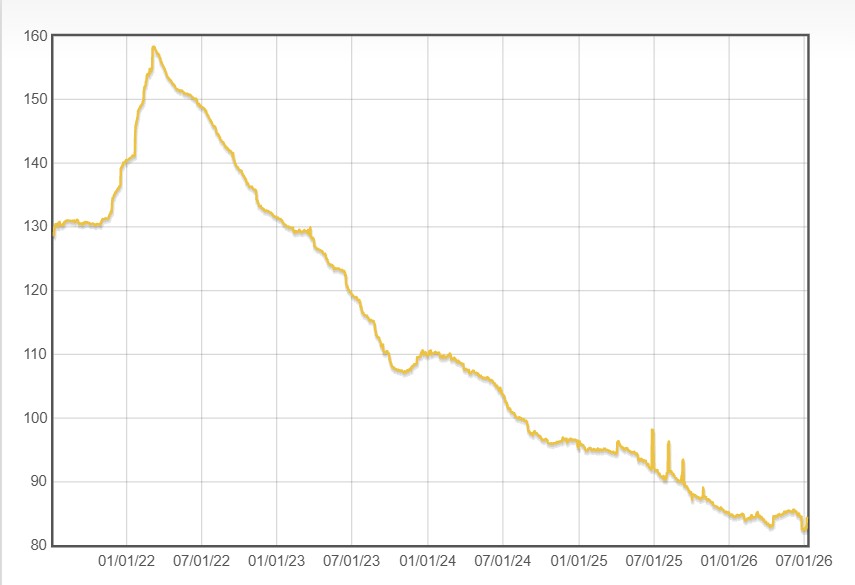
Source: Idexonline.com*
* Past performance is not a guarantee of future results.
[1] Forward-looking statements are based on assumptions and current expectations that may prove to be inaccurate, or on the current economic environment, which may change. Such statements are not guarantees of future performance. They involve risks and other uncertainties that are difficult to predict. Actual results may differ materially from those expressed or implied in any forward-looking statements.
This text constitutes a marketing communication. It does not constitute any form of investment advice or investment research, nor does it represent an offer to enter into any transaction involving a financial instrument. The content of this text does not take into account the individual circumstances, experience or financial situation of readers. Past performance is not a guarantee or prediction of future results.


.svg)
.svg)