

Strong quarter
In the second quarter, the results of which Klarna published on August 18, 2026, the company exceeded its own expectations across all key indicators. Gross merchandise value (GMV) processed through the platform increased by 18% year-on-year, while the company's revenue increased by 27% and exceeded USD 1 billion. Adjusted operating profit increased by USD 62 million from the same period last year and reached more than USD 90 million. An important event was that Klarna returned to profit, reporting a net profit of USD 9 million, while in the previous period it was still at a loss. For the company itself, according to its statement, transaction margin, which it uses to measure profitability, is important. It increased by 42% year-on-year to USD 446 million, representing more than 40% of revenue and also exceeding Klarna's May forecast. Earnings per share were USD 0.01, beating expectations of a loss of USD 0.06 per share.* Growth was also recorded in payment volume, transactions and, for example, the number of users.
With weaker expectations
Despite this, the results did not convince investors. The main problem was the new full-year outlook, which the company lowered. Full-year revenue is expected to reach USD 4.08 to 4.16 billion, while GMV is expected to be in the range of USD 149 to 151 billion, which would nevertheless still represent double-digit growth. For comparison, the previous estimate was USD 4.34 billion for revenue and USD 155 billion for GMV.[1] Klarna attributed the weaker outlook to lower consumer spending, particularly in its largest market, Germany. In addition, personnel changes were announced, with the chief financial officer and chief marketing officer set to leave the company at the beginning of next year.
Germany slows, US accelerates
The situation is not the same across individual markets. While German customers are more cautious about spending, especially on non-essential goods, Klarna's outlook assumes that these conditions are more likely to remain than improve. The situation was more favorable in the Nordic countries and also on the other side of the Atlantic. In the United States, GMV increased by 27% to almost USD 8 billion, accounting for 22% of the company's total volume, while revenue increased by 37% to USD 376 million and transaction margin by as much as 126%. Klarna expects the US market to continue its strong growth in the coming period. The integration of the Klarna platform with major players such as J.P. Morgan Payments should help in particular. Additional support could come from companies such as Adyen, Worldline and others. The expansion in America may therefore indicate that Klarna is partly compensating for weaker developments in Europe. [1]
Better margins are not enough
The results therefore show a company that is improving in some areas, but the stock market focused mainly on its weaker outlook. Shares fell during trading on August 18, 2026, and closed the day 22% lower at USD 15, which is more than half the price at which the company entered the stock market in September last year. Despite the sharp correction, Klarna is still only a few dollars above its historical low from March this year, when the shares were worth just over USD 12.*
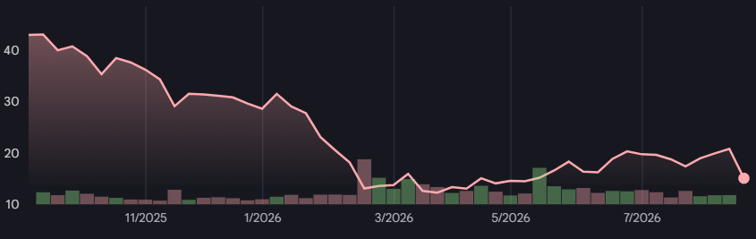
Development of Klarna's share price since its stock market debut in September 2025. Source: Google Finance*
Wants to become a fully-fledged bank
Klarna does not want to remain limited to its original "buy now, pay later" service and therefore applied to US federal authorities in July for permission to establish its own banking subsidiary. The subsidiary bank, called Klarna Bank USA in Utah, would be headed by Gary Harding, who already has experience running banks. The main advantage for Klarna would be that it would have its banking and lending activities under its own control and would not have to rely on partner banks. In addition, it could start expanding its portfolio of financial products, while it already offers savings accounts to US consumers through a partner bank.
Apple adds another major bet
Apple product lovers also have something to look forward to, as Klarna has entered into a partnership with the company. Through the Apple Upgrade program, customers in the US will be able to lease almost all devices from the technology giant. For two to three years, they will be able to obtain iPhones, Apple Watches, iPads or Macs through monthly payments. At the end of the lease, the product can be exchanged or purchased, while this model could be advantageous for the customer given the rising prices of Apple products. Apple has already increased the prices of some products by at least USD 100, and analysts expect further pressure on the prices of future products. For Klarna, the partnership is particularly significant because it allows it to participate in financing purchases directly within the ecosystem of one of the world's largest technology companies. Apple, in turn, may gain new customers, as leasing through Klarna will be cheaper than the existing leasing program offered by Apple. In addition, it could reduce the company's dependence on traditional mobile operators and also ease the seasonality of the business. [2]
* Past performance is not a guarantee of future results.
[1,2] Forward-looking statements are based on assumptions and current expectations that may be inaccurate, or on the current economic environment, which may change. Such statements are not a guarantee of future performance. They involve risks and other uncertainties that are difficult to predict. Results may differ materially from those expressed or implied in any forward-looking statements.
This text constitutes marketing communication. It is not any form of investment advice or investment research, nor an offer of any transaction in a financial instrument. The content of the text does not take into account the individual circumstances of readers, their experience or financial situation. Past performance is not a guarantee or prediction of future performance.


.svg)
.svg)