
What can we expect in the financial markets in 2026!
Market Structure: How to Identify the Market Trend?
One of the oldest and most true sayings in trading is that the trend is your friend. Market structure is the fundamental framework that tells you whether you should be looking for buying or selling opportunities.
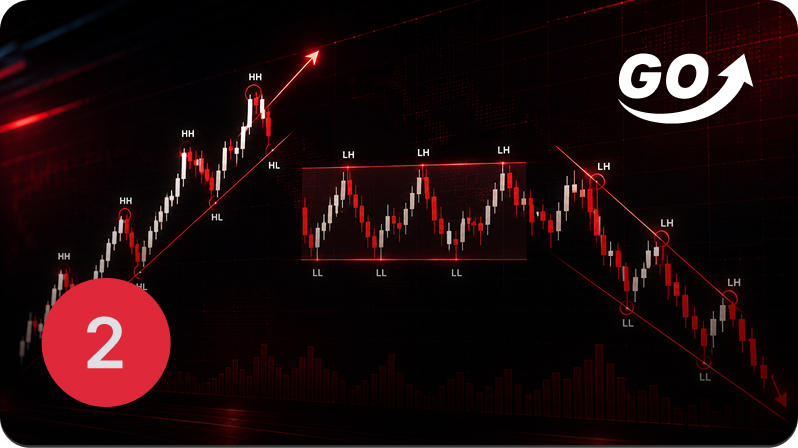
The market never moves in a straight line, but in a series of waves that form highs and lows. We define an uptrend as a sequence of higher highs and higher lows. This means that each new high is higher than the previous one, and each subsequent decline stops at a higher level than the one before it.
A downtrend is the exact opposite, where the market forms lower highs and lower lows, signaling a gradual outflow of capital and the dominance of selling pressure. The third phase is a market in a period of stagnation, when the price moves sideways within a certain range without a clear direction.
For successful trading, it is absolutely essential to be able to identify the current structure at all times. If you trade against the trend, your chances of making a profit are dramatically reduced because you are fighting against the main flow of money. A change in structure occurs when the market fails to make a new high in an uptrend and instead breaks below the previous low. This moment serves as a critical warning to traders that the previous momentum has run out and a reversal may follow.
Market structure provides you with the context in which you’re operating and helps you avoid unnecessary losses during periods when the market lacks a clear direction. Understanding market cycles—from accumulation through the trend to asset distribution—is key to strategically planning your entries and exits.
Navigation in the guide
Feel free to contact us
Feel free to send us any request. Our support team is available 5 days a week.
.svg)
+357 25 010426 (Mon–Fri 8:30–17:00)
.svg)
We will contact you shortly.
Risk warning: CFDs are complex instruments and come with a high risk of losing money rapidly due to leverage. 74.25% of retail investor accounts lose money when trading CFDs with this provider. You should consider whether you understand how CFDs work and whether you can afford to take the high risk of losing your money.